Legal
Rank First
A mixed 7 on 8 is legal if the ranks descend correctly.
Move Rule
Yes. Mixed suits can be stacked by rank, but only same-suit sequences can move together and clear from the tableau. In practice, the legal move is not always the best move, especially in 4-suit games where suit friction makes the board less flexible.
Direct Answer
You can place a card on top of another card that is one rank higher, even when the suits are different. That makes mixed-suit stacking legal. The limit is movement and removal: only a descending same-suit sequence can move as a group, and only a complete same-suit King-to-Ace run clears from the tableau.
Rule Evidence
The short answer is only the first step. The practical decision is sharper: a mixed-suit move can be legal, immobile, and strategically useful at the same time. Use the 4-suit board below as the mental model before you practice.
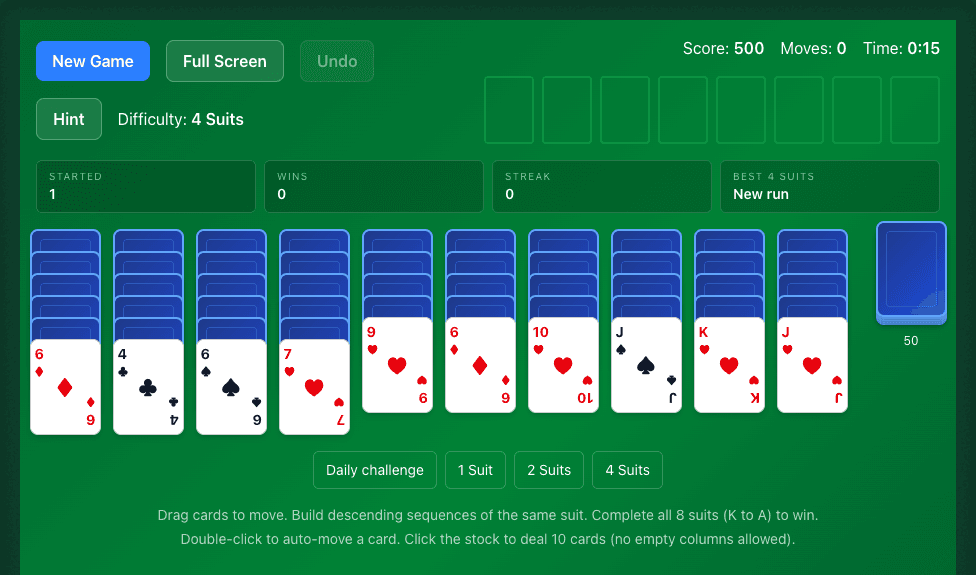
mixed-suit-practice-4-suit. It shows the same board type where mixed-suit stacking is legal but same-suit mobility decides how much of the tableau can move later.| Rule question | Mixed-suit result | Same-suit result | Player decision |
|---|---|---|---|
| Stacking a card | Legal by rank | Legal by rank | Take the mixed move only when it reveals, opens space, or prevents a worse block. |
| Moving a sequence | Not movable as one group | Movable if the cards descend cleanly | Protect same-suit runs when you need future mobility. |
| Clearing a run | Does not clear | King-to-Ace clears automatically | Use mixed suits as temporary scaffolding, not the final shape. |
| Score tradeoff on this site | Costs at least one move and may require cleanup | Usually costs fewer cleanup moves | A mixed move must buy information, space, or a stronger rebuild. |
Legal
A mixed 7 on 8 is legal if the ranks descend correctly.
Restriction
Only same-suit runs can travel together as a multi-card sequence.
Removal
A finished sequence must be same-suit before it disappears.
Decision Rule
Mix suits when the move reveals a face-down card, creates an empty column, or avoids a worse block. Those are the moves that improve flexibility later.
A legal mixed-suit move can still reduce same-suit mobility. That tradeoff is small in 1-suit play, noticeable in 2-suit play, and much more damaging in 4-suit games.
Score Impact
On Free Spider Solitaire, score starts at 500, every move subtracts 1, and every completed suit adds 100. That means a mixed-suit move is not automatically bad, but it needs to pay for itself by revealing a card, opening a column, or avoiding several cleanup moves later.
| Board situation | Immediate score cost | Decision | Why it matters |
|---|---|---|---|
| The mixed move reveals a face-down card | -1 point | Usually worth testing | New information can unlock several cleaner moves and prevent a worse stock deal. |
| The mixed move creates an empty column | -1 point | Often worth it | Empty columns are the best tool for splitting mixed stacks and rebuilding same-suit runs. |
| The mixed move only tidies visible cards | -1 point | Usually skip it | You spend score without revealing cards, opening space, or improving future mobility. |
| The mixed move breaks your only clean same-suit run | -1 point plus later cleanup | Avoid unless it prevents a dead end | The first move is cheap, but the later moves required to separate the stack can drain score. |
Compact example: moving 7 of Hearts onto 8 of Spades is legal. If it flips a hidden card, the -1 point may be a good trade. If it buries your only 7-6-5 same-suit run and later takes four moves to untangle, that one legal move may really cost five points.
Evidence
We analyzed 75,000 seeded opening deals from the live deck model, with 25,000 deals per difficulty. The striking pattern is that legal opening moves stay almost the same across difficulties, but same-suit mobility falls sharply in 4-suit. That means the board often looks playable even when future movement gets much worse.
This original data study uses a tested method and a fixed sample size per difficulty, so the comparison is repeatable rather than anecdotal.
| Difficulty | Avg legal opening moves | Avg same-suit opening moves | Starts with same-suit move |
|---|---|---|---|
| 1 Suit | 6.46 | 6.46 | 99.34% |
| 2 Suits | 6.43 | 3.20 | 96.12% |
| 4 Suits | 6.46 | 1.61 | 82.34% |
The takeaway is practical: mixed-suit moves are legal, but they are not neutral. In hard mode, every move that breaks a clean same-suit line can make the next several turns less mobile.
Replay Drill
The fastest way to learn this rule is to replay one board twice. On the first run, avoid the questionable mixed-suit move. On the second run, take it and compare whether the move revealed a card, opened a column, changed your score, or forced cleanup later.
Practice
Use the board below to test when a mixed-suit move is worth it. If you want the broader theory first, the opening-moves study and 4-suit strategy pages explain why preserving same-suit mobility matters so much.
See the 75,000-deal evidence behind the mobility tradeoff.
Learn how to protect mobility when mixed suits are unavoidable.
Review the legal move rules, stock rules, and winning condition.
Use a seeded 1-suit board to practice the movement rule before adding suit friction.
Measure whether mixed-suit cleanup moves are costing too many points.
Replay one board and compare two different mixed-suit decisions.
Practice the movement rule in the most flexible mode.
Try the middle difficulty where suit management starts to matter.
Play the hardest mode where mixed-suit friction is most visible.
Yes, you can stack mixed suits in descending rank order. But a mixed-suit sequence cannot move as a group, and it cannot be removed unless it becomes a full same-suit King-to-Ace run.
No. A mixed-suit sequence can sit in descending order, but it is locked as a group. To move multiple cards together, every card in that descending sequence must be the same suit.
Yes. You can stack different suits when the ranks descend, such as a 7 on an 8. The tradeoff is that the mixed stack usually has to be separated later before it can move as a group or clear.
Because 4-suit games create more suit friction. A move that is legal right now can reduce later mobility by breaking up clean same-suit runs, which makes the board harder to untangle.
No. Only a complete same-suit King-to-Ace sequence is removed automatically. Mixed-suit stacks can help you build or reveal cards, but they are not removable as a finished run.
Mix suits when the move reveals a hidden card, opens an empty column, or blocks a worse dead-end. Avoid mixed stacks that only make the board look tidy.
On this site, every move lowers score by 1. A mixed-suit move is worth the point only when it buys real board value, such as revealing a hidden card, creating an empty column, or preventing a worse blockage.
Use the daily board when you want the same deal to replay, or use the score-tracked page when you want to see how extra mixed-suit cleanup moves affect your final score.
Use a live Spider Solitaire game and try the 2-suit or 4-suit modes after reviewing the rules, scoring guide, and opening-moves study.