Sample
75,000 opening boards
25,000 deterministic deals in each standard mode.
Original Data Study
We analyzed 75,000 seeded opening deals to compare 1-suit, 2-suit, and 4-suit Spider Solitaire. The result: the number of legal opening moves barely changes, but same-suit mobility changes everything.
Sample
25,000 deterministic deals in each standard mode.
Modes
The study compares the same opening-board metrics across difficulty levels.
Measured
We counted visible mobility before a player makes the first move.
Limit
This measures opening friction, not full-game win probability.
Direct Answer
In our June 2026 simulation of 25,000 seeded deals per difficulty, 4-suit Spider Solitaire had about the same number of legal opening top-card moves as 1-suit, but only 82.34% of 4-suit starts had at least one same-suit opening move, compared with 99.34% in 1-suit. The hard part is not finding any move. It is finding a move that keeps the board mobile later. If terms like legal top move or same-suit mobility are new, use the Spider Solitaire glossary before reading the data table.
Sample
25,000 seeded opening deals for each difficulty mode.
Finding
Legal rank moves stay similar, but same-suit moves drop sharply in 4-suit.
Player Move
Prefer same-suit moves when they reveal cards or keep columns flexible.
Authority Signal
Spider Solitaire strategy pages commonly repeat the same advice: build same-suit sequences, reveal hidden cards, and avoid careless stock deals. This study gives those tips a measurable starting point by showing how much same-suit mobility changes before the first move.
| Source | Observed value | Player takeaway |
|---|---|---|
| Playable mode routes | The study links directly to the 1-suit, 2-suit, and 4-suit playable pages so the data can be tested in a real board. | Use the study as a mode-choice aid, not as a disconnected research post. |
| Study sample | The simulation sampled 25,000 deterministic opening deals for each standard mode, for 75,000 total opening boards. | This is the current first-party evidence asset for mode difficulty and same-suit mobility. |
| Surprising finding | Average legal top-card moves stayed near 6.4 across all modes, while same-suit moves dropped from 6.46 in 1 suit to 1.61 in 4 suits. | The useful distinction is specific: difficulty comes from mobility friction, not from simply having fewer legal moves. |
| Practice path | The current product has playable 1-suit, 2-suit, 4-suit, daily, rules, stock, and scoring routes. | Readers can test the study immediately by opening a matching playable board. |
Findings
| Difficulty | Avg legal top moves | Avg same-suit top moves | Zero-move starts | Starts with same-suit move | Avg visible suits |
|---|---|---|---|---|---|
| 1 Suit | 6.46 | 6.46 | 0.66% | 99.34% | 1.00 |
| 2 Suits | 6.43 | 3.20 | 0.57% | 96.12% | 2.00 |
| 4 Suits | 6.46 | 1.61 | 0.61% | 82.34% | 3.76 |
Legal moves and same-suit moves match.
About half the visible legal options preserve suit continuity.
Legal options remain, but clean mobility is much scarcer.
Method
We used the same deck model as the live game: 104 cards, 10 tableau columns, 54 tableau cards, and 50 stock cards. The first four columns receive six cards each; the remaining six columns receive five cards each.
Each difficulty was simulated with 25,000 deterministic seeds. For every opening board, we counted legal top-card moves by rank, same-suit top-card moves, zero-move starts, visible rank variety, visible suit variety, and first-stock-row potential moves.
This is not a full solver and does not claim that a deal is winnable or unwinnable. It measures the opening-board friction a human player sees before making the first move.
The downloadable aggregate data below contains the mode-level results used in this article. Each mode used 25,000 deterministic starts so the same sample can be checked again.
Download the aggregate metrics as a CSV: spider-solitaire-opening-moves-study.csv. The file contains the same mode-level fields used in the table above: legal top moves, same-suit top moves, zero-move starts, same-suit starts, visible ranks, visible suits, and first-stock-row potential moves.
What It Means
Every legal descending move is also same-suit, so the opening board rewards movement and card reveals. This is why 1-suit is the best practice mode for learning the rules.
A legal descending move can create a mixed-suit stack that cannot move as a group later. The board may show plenty of moves, but fewer of them preserve future flexibility.
Player Decision Table
Use the study as a filter before you move. A move can be legal, but the better question is whether it reveals information, protects a clean run, or preserves room for the next stock decision.
| Board signal | Why it matters | Practice route |
|---|---|---|
| Legal move is same-suit and reveals a hidden card | It adds information while keeping the moved stack mobile later. | Use 2 suits to practice choosing clean moves under light suit pressure. |
| Legal move is mixed-suit and does not reveal anything | It can make the board look active while reducing future stack mobility. | Check the mixed-suit rule page before taking cosmetic moves. |
| No useful tableau move remains before the stock | A stock deal adds 10 cards and can bury cards that were still recoverable. | Use the stock timing page before dealing. |
| You are learning the rule pattern for the first time | 1 suit removes suit friction so legal moves and movable stacks are the same category. | Start in 1 suit, then move upward. |
| You want the hardest standard mobility test | 4 suits keeps legal-move counts similar but sharply reduces same-suit mobility. | Practice the study finding in 4 suits. |
Board Interpretation
The useful distinction in Spider Solitaire is not just whether a move is legal. It is whether the move keeps the board mobile. A legal move may be available in every mode, but in 4-suit the same move can create a mixed-suit stack that is harder to move later. Same-suit mobility is the better measure of board health.
1-suit start
6.46 avg legal top moves / 6.46 avg same-suit top moves
In 1-suit, every legal descending move preserves suit continuity. The board rewards movement immediately because a move that is legal is also a move that keeps future mobility intact.
2-suit start
6.43 avg legal top moves / 3.20 avg same-suit top moves
This is where a playable-looking board starts to split into two categories: moves that simply fit the rank pattern and moves that keep the stack usable later.
4-suit start
6.46 avg legal top moves / 1.61 avg same-suit top moves
Four suits can look as open as 1-suit at first glance, but most legal options do not preserve suit mobility. That is why 4-suit feels playable and still collapses into friction.
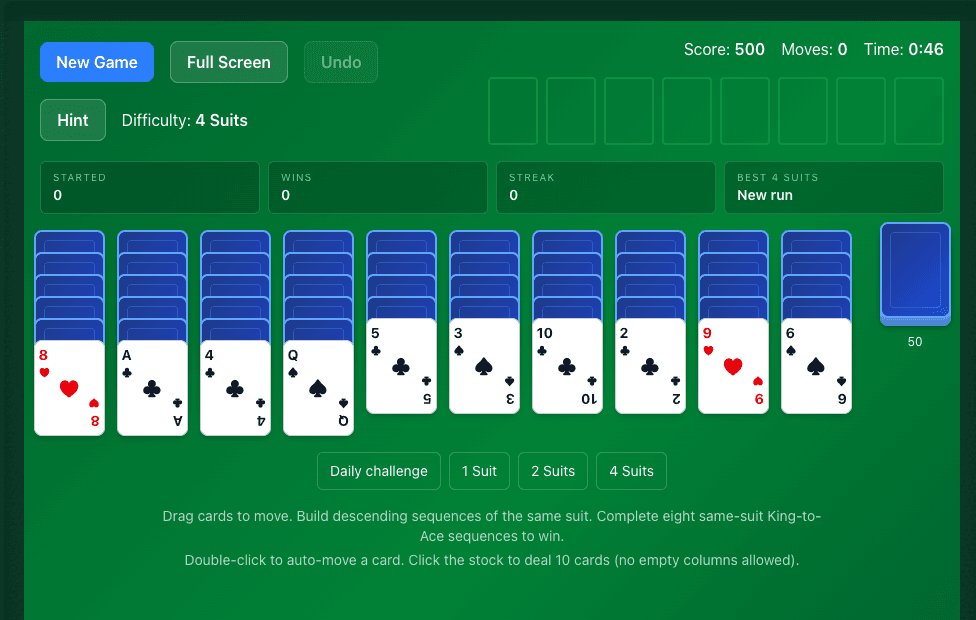
opening-study-4-suit-v1. The player decision is visible here: legal moves are not necessarily same-suit movable runs, so compare suit continuity before moving.Evidence Plan
The board examples above pair study interpretation with a reproducible first-party game state. The screenshot is a seeded example, not a claim about the study average or a win probability.
Practice the Finding
On your first moves, count how many legal options also keep the suit together. That small difference is what turns a playable-looking board into a hard 4-suit game.
See why legal mixed-suit moves can lower future mobility.
Learn how to keep same-suit sequences mobile in hard mode.
Use open spaces to repair mixed-suit friction and expose hidden cards.
Do not add 10 stock cards until you have used the board's useful options.
Connect move quality, completed suits, and replay intent to score outcomes.
The best first move is usually a same-suit move that reveals a hidden card or keeps a clean sequence mobile. If the only legal moves are mixed-suit moves that reveal nothing, pause before moving because the board may lose flexibility later.
Sometimes, but treat it as a tradeoff. Mixed-suit moves can be necessary, especially in 4-suit, but our opening-board data shows that same-suit mobility is much scarcer in harder modes. Prefer mixed-suit moves when they reveal cards, create space, or unlock a stronger next move.
In our 75,000-deal simulation, 4-suit starts had nearly the same number of rank-legal top-card moves as 1-suit starts, but far fewer same-suit moves. The difficulty comes from suit friction, not from having fewer visible moves.
The study measured opening-board metrics across 25,000 seeded deals per difficulty: legal top-card moves, same-suit top-card moves, zero-move starts, visible rank variety, visible suit variety, and first-stock-row potential moves.
No. This study measures opening-board mobility, not full-game solvability. It is useful for understanding why some starts feel flexible while others create long-term suit-management problems.
Do not treat every legal move as equal. In 2-suit and 4-suit Spider Solitaire, same-suit moves preserve future mobility, while mixed-suit moves can look legal but make the board harder to untangle.